Monday, October 20, 2014

SHOULD AUTONOMOUS WEAPONS BE BANNED?


SHOULD AUTONOMOUS WEAPONS BE BANNED?

Well, this is an article, not a book, so let’s take out of the table the secondary aspects of what we are analyzing. 
Autonomous non-lethal, non-permanent damage inflicting weapons of course can be used.  They can prevent violence until a human officer can take charge of the situation.  We must keep in mind that mal-functioning issues can occur, and that’s why I’m emphasizing that these weapons shall not be capable of inflicting any permanent injury.

So, the autonomous weapons we are debating about are the lethal ones.
In technical terms, we are talking about what the specialists call “LAWS” – Lethal Autonomous Weapons Systems; systems where a human does not make the final decision for a machine to take a potentially lethal action.
Where would a lethal weapon first used, or more probably used?  At war, of course.
So let’s take a look at war.

War is not a sport.  It is not about “fair play”.  When you are, for example, defending your country of a foreign invasion, there is too much at stake.  What matters is not to fight a “fair fight”, but to win!  And strategy is about attacking when our enemy is weak and retreating when he is strong, deceiving, trapping…  As the saying goes, “it’s not about dying for your country, it’s about making the enemy die”.  And, in my point of view, doing this until all enemies are exterminated or surrender unconditionally.
Even in this raw terms, as long as war is confined to soldiers fighting soldiers, I don’t feel it as so hideous. And the more efficient we are in war, the less likely non-combatants will be harmed.

I’ve read Erich Maria Remarque’s World War I descriptions (All Quiet in the Western Front).  The trenches.  The artillery bombings.  Did an artilleryman know where was his cannon hitting?  Not at all!  So, in this sense, the autonomous systems are just one step ahead, in a path that started with the longbows .
Notice that even if in All Quiet in the Western Front Remarque describes war as useless and insane, his main character in Arche du Triomphe kills a war criminal without any remorse.  Remarque denounced the evils of war, but by no means advocated that evil shall be allowed to act freely!

From what I said above, you can deduce that I do not just think that it can be morally acceptable to kill an opponent in combat.  I think that it can become a moral duty, actually, if you are defending your freedom, your country, your family.   And I do believe that, in these circumstances, it doesn’t really matters if you are using your hands, a sword or just pushing a button.   But it must be you to push the button.  Your decision, your responsibility.

In brief:
Weapons Systems?  Yes, definitely.  They are ultimate weapons.  They can save lives of human soldiers.
Autonomous? No, not at all!

Specialists in international laws say that these autonomous lethal systems would create a “legal void”, that people could be killed and nobody would be accountable.   After all, the systems are autonomous, aren´t they?  So no human being made the decision of using lethal force.  A machine did.  Will we sue a machine as war criminal? 
With autonomous systems, there will be victims, but there will be no criminal!

I am an old timer, so let me present an old fashioned argument:  if we allow a machine to kill in our behalf, where will be the honor of the warrior?
I know, a lot of people do not believe that it exists at all.  Or so they claim.  They say that violence is never morally admissible, and that there is no honor in fighting.  They just forget that they can afford to be pacifist because warriors protected their freedom and peace in the past and still do protect nowadays!
But the warrior must be a man.  Must be able to look into his opponent´s eyes, if needed.  Yes, war is more and more based in sophisticated weapons.  Physical powerfulness is not what decides battles.   But I do believe that, to have the moral right of pressing a button to use a lethal weapon, we need to be willing to use our bare hands if necessary!
Primarily and above all - we cannot renounce our moral duty of making the decision of getting into battle and take another human being’s life! 
 If we delegate not only the action, but the decision, to a machine, we´ll be taking away the human status of the enemies.  And, furthermore, we will be no more warriors, but butchers.

That´s how I see the question.


Please allow me to finish with some quotes:

“Any decision to kill needs to be made by a human!”
 Jody Williams, Nobel Peace Prize.

“If we do not put an end to this trend for automating warfare now, we could face a very bleak future where machines are delegated with the decision to kill humans. This is perhaps the ultimate human indignity and crosses a fundamental moral line which needs to be considered and addressed.”
Professor Noel Sharkey from the University of Sheffield's Department of Computer Science


Further Readings:
·         Robotics expert helps global leaders decide ‘killer robots’ policies - http://www.sheffield.ac.uk/news/nr/robotics-expert-killer-robots-un-debate-1.373321
·         Here's The World's First Robotics Company To Pledge Not To Make 'Killer Robots'  - http://www.businessinsider.com/clearpath-robotics-joins-campaign-to-stop-killer-robots-2014-8
·         Does the World Want Lethal Autonomous Robots? - http://www.techthefuture.com/future/does-the-world-want-lethal-autonomous-robots/


Further Information:
Losing Humanity - The Case against Killer Robots - http://www.hrw.org/reports/2012/11/19/losing-humanity-0


Monday, October 13, 2014

How has the Internet Changed my Life

How has the Interned Influenced Me?

A little bit of the Old Times

That’s an interesting question, since I’m old, and I’ve lived in a world not just without Internet, but without personal computers!
Well, I´ve lived in a world without computers, period!  J
My first contact with computers was around 1972.  I worked in the accounting department of a large chain of stores in Brazil, and we in the Pelotas (a city near the State´s capital) branch received some reports – inventory position, sales summaries, etc. – from the headquarters in Rio de Janeiro.  “These reports were printed by a computer, ooooh!”   But I had never seen a computer – neither none of my colleagues, I think.
Then in 1975 a new company was established in Pelotas (check the map below, or at Google - https://www.google.com/maps/place/Pelotas+-+RS,+Brazil/@-5.6312841,-102.7326842,3z/data=!4m2!3m1!1s0x95104991ad796447:0x99bab4aec1bd644f ), and it brought an “electronic brain” to the city!  And since accounting machines were the stuff most similar to computers in town, I have been hired.  I was 19, with no formal training in computing, none at all.  I attended an in-house COBOL programming course and became an intern programmer.


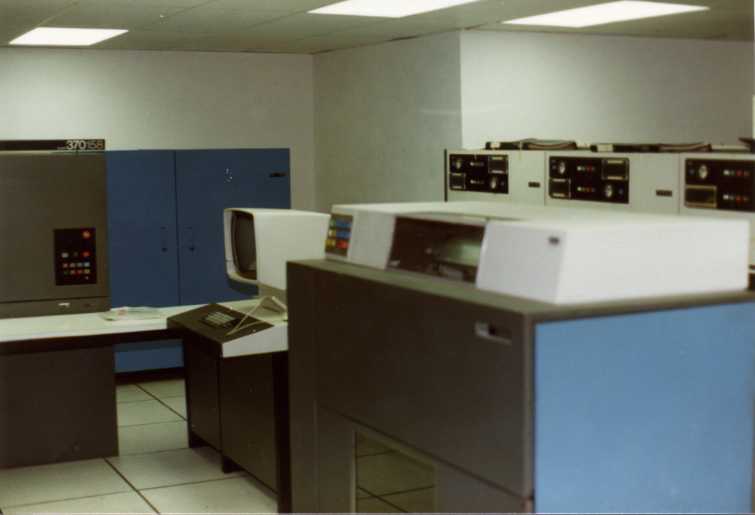
It was an IBM/370, running DOS/VS, and we used mostly COBOL, despite the “Chief of Programming” (yes, we didn´t have fancy names like “Software Development Manager” at that time! J ) being an Assembler programmer.  It was all about batch processing and since this we programmers worked at desks, coding our programs in paper forms, then punching it in cards, and then sending the card decks to the “computer room” to compile our program and catalog it in a library, in disk.
The images below are pretty similar to the computer room at this company:


After our programs were ready (compiled, link-edited, tested, catalogued in an “executable library” in disk) we send to the Computer Operator a flowchart describing how to execute it in production – how many and which magnetic tapes should be read and/or recorded (there was a tape-library, they were identified by numbers), what disc unitis should be used (yes, the hard discs were removable!) if it would need use the printer, etc.
The Computer Operator was like a priest of the sacred ritual of “executing batch processing”!  And the holy precincts of the computer was - taboo! - forbidden ground to the ordinary mortal! :-) 

And that way we processed the City Hall Real Estate Taxes Control System, the City Hall Payroll, and others.  My favorite was the Banking System, for the Rio Grande do Sul State´s Bank.  There was no ATMs, no bar codes in the checks, no computer workstations for the tellers…  How things did work?
Every morning, we (we the Processing Data Center, the sacred priests of the mysteries of the Computer J ) sent to each bank agency a set of books, listing the balance of each and every account belonging to the agency.  Each time a customer reached a teller to exchange a check for cash, the teller would query the book, check if the account balance was enough and if so they´d give the customer his cash and handwrite in the book, aside the balance value – “minus BRL 100”, for example.  That way the teller kind of "temporarily updated" the balance.
At the end of the day,all checks (and other related documents) were sent to the Processing Data Center.  And we typed the data of each check!  In a matter of four or five hours, a team of five or six people typed the data of six or eight thousand checks!  Around midnight, the data started to be processed, computing the new balances.  And around 04 PM a car fleet departed to deliver the new books with the updated data.
I´m kind of simplifying the things.  There was also Quality Control processes called “Data Preparation” and “Consistence Checking”, with whole departments assigned to.  And, of course, there was the implementation of new bank agencies, when we had to type all data – name, address, etc. – of all customers and their balance values in a weekend.  If we did not finish in an weekend, when the bank was closed, we´d have to “abort the mission” and try again the next weekend!  In one of these “hellish-weekends”, I and a couple of colleagues went to a bank to get more documents to transcribe.  We got a taxi for it.  When the taxi driver saw us getting out of the bank, at 03 AM, carrying some big metal boxes, he get out of the car, and with a weak trembling voice, asked “Please, take the car, but let me go away”! J
These were the old, “epic” times of data processing, and we old timers have lots of stories about sleepless nights to share! J


A Radical Change – Skype, VPNs, Shared Documents, Remote Desktops
Shifting to the present times:  from the beginning of 2012 until the end of 2013 I worked for an American company.  Except for a 2 weeks starting period in the headquarters (Roanoke, Virginia), I worked from home.
My daily routine was to get up around 7 AM, walk the dogs, calmly have my breakfast, and at 9 AM turn on my computer and connect to the company´s Virtual Private Network (VPN). 
In one work day I could have some scrum meetings thru Skype, follow and update the progress of projects I was working on thru Sharepoint-supported documents…  Notice that the team members chatting thru Skype could be in several Brazilian States and also in the United States, Europe, Asia…  And that the Sharepoint server was in United States.
One typical activity was access our customer´s computers to do software development and/or to administer system resources.  I´ve worked for companies inside Brazil, but at some 1500 km from my home-office, without leaving my living room!  And I have worked the same way for companies in United States!  
The customers do receive the solution they need, as if I had been there.
My employers save the money and time I would spend travelling.
And I, instead of having to travel, could work at home, without having to spend time going to office every day,  sometimes being able to pick my teenage daughter at school, sometimes preparing the family´s lunch, as a caress to welcome them…  Not to mention the extremely cold, or extremely hot,  or rainy days, when instead of facing the unpleasant whether I could just sit at my desk at home, wearing comfortable staying-home clothes!
Was it like vacations?  No, it wasn´t! 
The commitment to deliver increases, when you´re working from home.  The only thing your manager sees is what you deliver, nobody cares about the effort you did but didn´t solve the problem! 
You need to create your own daily work routine – and be extremely disciplined following it!  You need to manage yourself.
You need teach your family also, make them understand that at business hours you are at home, but you are not available.  You are at work!
And you need to teach yourself when it´s time to stop working and be at home with your family again.  The same way you must be alert to not lose the focus in your work at business hours, you need also learn not forget to stop working when it´s time!
There will still be extra work hours, of course.  But I can tell that is a lot better a sleepless night at my home-office, being able to grab a coffee and a snack whenever I want, being in the same house than my family, than to spend a night at the office, dinning cold pizza in an empty building!

I now own a small software development company in Brazil – PPAI Sistemas de Informação Ltda (www.ppai.com.br).  As soon as I finish my time at KSU, I expect to be able to do business with companies spread across all the Brazilian territory and abroad also.
And, last but not least – thanks to the Internet, I will be able to be paid remotely!


And Shifting from Work to Personal Life…

E-mails
I had a sister, who passed the way last year.  She lived in Denmark.  The first years she lived there, we almost lost all contact.  But then…  the e-mail appeared!  And it was like a good fairy spell, we could talk with each other again, share with each other again - in a matter of minutes, no more 20 or 30 days waiting for the snail-mail!  The conversations we had by e-mail meant a lot, made a lot of difference in my capability to accept her death!

Without Skype and Facebook I probably Would not be at KSU!
And without Skype I probably would not be at KSU!  I wouldn´t be able to be so far away from my daughter if I was not able to talk with her daily, listen to her voice, see her lovely face…
Thru Skype and Facebook I can be aware of her daily life, chat with her, share my pictures and see hers… It´s not like sitting side by side at home, but it´s a lot better than letters or phone calls!
I´m even able to “be the daddy” remotely!  J  Like advising how to manage school issues, to what vet the dogs should be taken – and, as daddies always do, sending the money to pay the vet!
So, thanks to Skype, Facebook and Internet Banking, I´m at KSU and at the same time I´m not completely away from Brazil!


Miscelaneous  Listening to Music, Reading, Studying…
I think I already wrote a lot.  So I´ll just mention that everything about books, discs, encyclopedias and text books, changed radically.  We listen the music we want whenever we want, we read (almost) every book for free or at a low cost, and, at my home, “Lets check at Google” is a mantra at study time!


Tuesday, October 7, 2014

The Pattern on the Stone - by W.Daniel Hillis Brief Comments

The Pattern on the Stone is a very interesting book.  It accomplishes its purpose of describing “the simple concepts that make computers work”.   It carries the reader from the fundamental concepts of computing, explained in a simple, interesting and clear way, to the threshold of the future, when computers could build themselves, learn, think and – maybe – feel as a living being!
Let me highlight some strong points and also some opportunities for improvement I think I saw.


Universal Computer, Building Blocks, Boolean Logic, Finite State Machines
I found these initial chapters one of the best parts of the book.  In the Preface, the author already introduces the idea that a computer can be built of several materials, not necessarily electronic, since their essential nature transcends technology. 
I had heard about “biological computers”, for example, but did not really understand how it could work until I read the book and its explanations about the Universal Computer.  The examples the author provides with pipes and valves and with strings and sticks are simple and provide a complete understanding of the basic concept.

Programming
I think the programming classes our teacher Russel Feldhausen gives us are better than the book's explanations about programming.  The explanations are not bad, but are outdated, and does not cover all programming language paradigms.  Being a basic book, it could not mention Functional Programming, Logic Programming or Symbolic Programming (see http://en.wikipedia.org/wiki/Programming_paradigm ;  see also http://people.cs.aau.dk/~normark/prog3-03/html/notes/paradigms_themes-paradigm-overview-section.html ).  But I think it could describe a simple Declarative Language as, for example, SQL.  And I felt that this part of the book lacks examples as good as the initial chapters.  I’m not sure if somebody can actually understand how a procedural program works just based on the book.

Algorithms and Heuristics
Again, a series of chapters that I enjoyed the most!  The book explains how heuristics makes  possible dealing with “un-computable” problems, using search spaces and hill climbing method.    
I found remarkable how heuristics moves computing out of the “true or false” terrain, into the land of “educated and well-considered guesses”.  That brings computers operation a lot closer to human being’s reasoning – and, thanks to Daniel Hillis, now I know how this is done!

Parallel Computing, Machine Learning, Neural Networks, Simulated Evolution
These chapters are not so easy to read – and understand – as the initial ones.  These difficulties would be expected, since the subjects are more complex.  But the author did a good job explaining the fundamental concepts and providing examples.  The description of the creation of “sorting programs” thru “evolution” amazed me!   “Simulated Evolution” producing programs more efficient than the author could write, and, furthermore, programs that he cannot understand how they work?!  That’s something to think about!  I’m not sure if I’m amazed, scary, or both!

  
A final remark over Analogic Computers
I felt the fact that difference between analogic and digital computers is not just of precision could have been emphasized.  The difference in precision can even be irrelevant, as the author points out.  What he does not highlight is that an analogic computer is comparing actual objects, is measuring the real world, and a digital computer will always work with symbols.  I’m not saying that one is better than another, I’m just saying that they are different in this fundamental way.  Since the focus of the book is digital computers, it’s understandable.  But I like to highlight that everything inside digital computers is virtual.  Abstractions, symbols, not the real world.  And due to the high importance digital computers affect our lives in real word, it could be wise to keep this in mind!